First part, to decompose each cubic into a sum of squares, then compose them from different direction.
Let
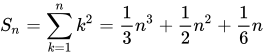
so
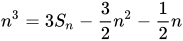
apply it to 
![{\displaystyle n^{3}=3[1^{2}+2^{2}+...+(n-1)^{2}+n^{2}]-{\frac {3}{2}}n^{2}-{\frac {1}{2}}n}](https://wikimedia.org/api/rest_v1/media/math/render/svg/d16e9c2d38bbda27acc5d1fa75c8b45884b76d64)
![{\displaystyle (n-1)^{3}=3[1^{2}+2^{2}+...+(n-1)^{2}]-{\frac {3}{2}}(n-1)^{2}-{\frac {1}{2}}(n-1)}](https://wikimedia.org/api/rest_v1/media/math/render/svg/8c8aecf65864a6ffc135d429f97f694cf10380cc)
...
![{\displaystyle 2^{3}=3[1^{2}+2^{2}]-{\frac {3}{2}}2^{2}-{\frac {1}{2}}2}](https://wikimedia.org/api/rest_v1/media/math/render/svg/b60b5bf9d891d1e1af8ee748b7c0cb98da9f797b)
![{\displaystyle 1^{3}=3[1^{2}]-{\frac {3}{2}}1^{2}-{\frac {1}{2}}1}](https://wikimedia.org/api/rest_v1/media/math/render/svg/8d6b8a5a97ae039951579d7fa4e8a4edfc226936)
To sum these n identities, let
![{\displaystyle R_{n}=\sum _{k=1}^{n}k^{3}=3[1^{2}*n+2^{2}*(n-1)+...+(n-1)^{2}*2+n^{2}*1]-{\frac {3}{2}}S_{n}-{\frac {1}{2}}T_{n}}](https://wikimedia.org/api/rest_v1/media/math/render/svg/f6219dee12a16b56403511063ff75c2424070f7a)
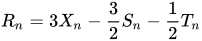
where

![{\displaystyle X_{n}=3[1^{2}*n+2^{2}*(n-1)+...+(n-1)^{2}*2+n^{2}*1]}](https://wikimedia.org/api/rest_v1/media/math/render/svg/ca03bc61c6f18a381a6bbb0030243d9aadb80499)
Second part, make use of  ; apply it to
  :
:
![{\displaystyle (n+1)^{3}=[1+n]^{3}=1^{3}+3*1^{2}*n+3*1*n^{2}+n^{3}}](https://wikimedia.org/api/rest_v1/media/math/render/svg/488150ea1f2cbf65bdb026f5de2bd6080af05ce2)
![{\displaystyle (n+1)^{3}=[2+(n-1)]^{3}=2^{3}+3*2^{2}*(n-1)+3*2*(n-1)^{2}+(n-1)^{3}}](https://wikimedia.org/api/rest_v1/media/math/render/svg/ad676c9a4bde7d3612aeda86f994a4fef8f2377d)
...
![{\displaystyle (n+1)^{3}=[n+1]^{3}=n^{3}+3*n^{2}*1+3*n*1^{2}+1^{3}}](https://wikimedia.org/api/rest_v1/media/math/render/svg/e2c1865f4b5dde40c44b5b3dd3e9816ecd3a36d1)
To sum these n identities,
![{\displaystyle n(n+1)^{3}=R_{n}+3\left[1^{2}*n+2^{2}*(n-1)+...+(n-1)^{2}*2+n^{2}*1\right]+3\left[1^{2}*n+2^{2}*(n-1)+...+(n-1)^{2}*2+n^{2}*1\right]+R_{n}}](https://wikimedia.org/api/rest_v1/media/math/render/svg/8cc3e88c205913fb87e8fc69c1219f2bfee1b233)

OK, easy part now, to merge the results of first part and second part, we can get
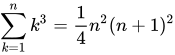
BTW, Archimedes would use  at first part, and use
  at second part.